Verifactu for autónomos: step-by-step compliance checklist
From 1 July 2027, every autónomo in Spain who issues invoices must use a certified invoicing system (SIF) that complies with Verifactu, the mandatory invoicing verification regulation introduced by the Ley Antifraude. Non-compliance carries a fixed fine of €50,000 per fiscal year, regardless of the size of your business or how many invoices you issued. This article gives you the exact checklist to verify whether you are compliant, what steps to take before the deadline, and what common mistakes to avoid.
Last verified: July 2026. Sources: Real Decreto 1007/2023, AEAT Sede Electrónica.
Who must comply with Verifactu
Verifactu applies to all natural persons and legal entities subject to Spanish corporate income tax (IS) or personal income tax (IRPF) who use computerised invoicing systems. In practice, this means:
Autónomos (self-employed) who issue invoices using any software, app, or digital tool. Deadline: 1 July 2027.
SLs and other companies subject to corporate tax. Deadline: 1 January 2027.
Autónomos in módulos (objective estimation regime) who issue invoices are also in scope. Being in módulos does not exempt you.
Autónomos who invoice only one client (dependent self-employed, TRADE) are in scope if they use invoicing software.
You are NOT in scope if:
You are already enrolled in the SII system (Suministro Inmediato de Información), which applies to businesses with turnover above €6 million. SII replaces Verifactu for these entities.
You issue all invoices by hand (handwritten paper invoices). The regulation targets computerised systems. However, AEAT is watching this closely and manual exemptions are narrow.
You are a non-resident entity with no permanent establishment in Spain invoicing from abroad.
Key dates and deadlines
29 July 2025: Software vendors had until this date to release a Verifactu-certified version of their product and file their declaración responsable with AEAT.
1 January 2027: Mandatory compliance deadline for SLs and all entities subject to corporate tax. From this date, every invoice must be issued through a certified SIF.
1 July 2027: Mandatory compliance deadline for autónomos subject to IRPF. From this date, every invoice you issue must be generated by a Verifactu-certified system.
From your deadline onward: Every invoice issued through a non-compliant system is a direct infraction of the Ley Antifraude, triggering the €50,000 fine per fiscal year.
Verifactu requires you to use a certified SIF (Sistema Informático de Facturación) for every invoice you issue. A SIF must:
Generate a tamper-proof hash chain that links each invoice to the previous one, making it impossible to modify or delete invoices after the fact without detection.
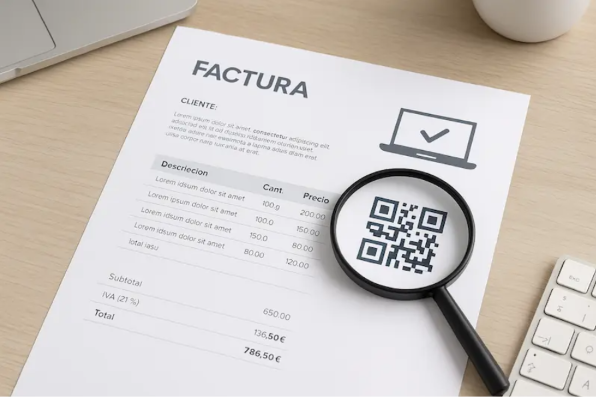
Produce a Verifactu QR code on every invoice. When scanned, the QR takes the recipient to AEAT's verification portal, confirming the invoice was registered. More on how the QR works: Verifactu QR code: what it is and how it works.
Operate in one of two modes: VERI*FACTU mode (sends invoice records to AEAT in real time at the moment of issue) or no-VERI*FACTU mode (stores records locally with a digital signature, available for AEAT inspection on request). Most small business software uses VERI*FACTU mode by default.
Keep an immutable audit log of every action: invoice creation, modification, cancellation, with timestamps.
Have a declaración responsable filed by the software vendor with AEAT, confirming the system meets all technical requirements under Real Decreto 1007/2023.
You do not register separately with AEAT for Verifactu. There is no form to file. Compliance is built into how your invoicing software works from your deadline date.
Penalties for non-compliance
Using non-compliant invoicing software after your deadline: €50,000 fixed fine per fiscal year. This is a per-infraction penalty tied to the Ley Antifraude (Ley 11/2021), not a percentage of revenue.
Software that allows modification or deletion of issued invoices (considered fraudulent): up to €50,000 per infraction, potentially applied per invoice if systematic manipulation is found.
Failure to include the QR code on invoices after the deadline: separate infraction, same penalty tier.
The penalty is fixed, not proportional. A freelancer billing €15,000 a year faces the same €50,000 fine as a business billing €500,000. This is intentional: the regulation targets the system used, not the revenue generated.
Action checklist: how to comply before 1 July 2027
Work through these steps in order. Each one must be completed before your deadline.
Find out what software you currently use to issue invoices. If you use Excel, Word, or a generic PDF tool, you are not using a certified SIF and will need to switch. If you use dedicated invoicing or accounting software, move to step 2.
Ask your software vendor for their declaración responsable. Email or call and ask: "¿Vuestro software está certificado como SIF bajo el Real Decreto 1007/2023? ¿Podéis enviarme la declaración responsable?" A compliant vendor will answer immediately. If they hesitate, that is your answer.
Verify your vendor on the AEAT registry. AEAT publishes a list of software that has been declared compliant. Search for your provider at the AEAT Sede Electrónica under "Sistemas informáticos de facturación." If your vendor is not on the list, assume non-compliance until confirmed otherwise.
Check whether your invoices already carry a Verifactu QR code. If your software is already operating in compliant mode, your invoices will have a QR code and a verification hash (código de verificación). If your invoices look the same as they did two years ago, the software has not yet been updated.
If your software is not compliant, switch before Q4 2026. Do not wait until June 2027. Migrating invoicing software mid-fiscal year creates numbering and continuity issues. Switch in Q4 2026 at the latest. For free compliant options, see Verifactu free: how to comply at zero cost.
Export your historical invoice data before switching. Before leaving your current software, export all past invoices in a format you can store (PDF and CSV at minimum). Your obligation to keep invoice records for four years does not disappear when you switch systems.
Test that the new system generates QR codes on every invoice. Issue a test invoice to yourself and scan the QR. It should take you to AEAT's verification portal and confirm the invoice was registered. If the QR does not scan or takes you to a non-AEAT page, the system is not operating correctly.
Keep your declaración responsable on file. In a tax inspection, you may be asked to prove your system is certified. Keep the vendor's declaración responsable in your records alongside your invoices.
If you use custom-built internal software, you must file your own declaración responsable with AEAT and ensure the system meets all technical requirements of Real Decreto 1007/2023. This requires technical development and legal review. Start immediately if this applies to you.
Common misunderstandings about Verifactu
"I am in módulos, so Verifactu does not apply to me." Wrong. Being in the objective estimation regime (módulos) does not exempt you from Verifactu. If you issue invoices using any software, you must comply by 1 July 2027.
"My software is cloud-based, so it must already comply." Cloud-based does not mean Verifactu-certified. Many cloud invoicing tools used by Spanish freelancers had not been updated by the July 2025 vendor deadline. Always ask for the declaración responsable explicitly.
"I only issue a few invoices a year, so the regulation does not apply to me." There is no minimum invoice volume. The regulation applies to any autónomo who uses computerised invoicing, regardless of how many invoices they issue.
"Verifactu is the same as the mandatory electronic invoice." They are different regulations. Verifactu applies to your invoicing software and affects all invoices (to businesses and consumers). The mandatory electronic invoice (Ley Crea y Crece) applies specifically to B2B invoicing and is on a separate timeline. See the difference between Verifactu and electronic invoice.
"I have until January 2027." That deadline is for SLs and companies subject to corporate tax. Autónomos have until 1 July 2027. Do not confuse the two.
What happens if the regulation changes
Verifactu has already been delayed once. The original implementation dates were pushed back under pressure from software vendors who needed more time to certify their products. Another delay is possible but cannot be assumed. Plan for the current deadline of 1 July 2027.
Where to monitor for changes:
BOE (boe.es): any delay or modification to Real Decreto 1007/2023 will appear here first.
AEAT Sede Electrónica: AEAT publishes practical guidance and FAQ updates when the regulation changes.
Your software vendor: compliant vendors will notify you proactively if the deadline shifts and what it means for your system.
Verifactu for autónomos: frequently asked questions
Do I need to register with AEAT to use Verifactu?
No. There is no registration process for autónomos. Compliance is built into your invoicing software. From 1 July 2027, every invoice you issue must come from a certified SIF. If your software is certified, you are compliant automatically.
What is a SIF and how do I know if my software is one?
A SIF (Sistema Informático de Facturación) is a certified invoicing system that meets the technical requirements of Real Decreto 1007/2023. Ask your software vendor for their declaración responsable, or check the AEAT registry of certified systems. If your invoices already carry a Verifactu QR code and a verification hash, your software is operating as a SIF.
Can I keep using Excel to invoice after July 2027?
No. Excel is not a certified SIF. From 1 July 2027, all invoices must be generated by a certified system. Using Excel after that date is a direct infraction carrying a €50,000 fine per fiscal year. For free alternatives, see Verifactu free: how to comply at zero cost.
Does Verifactu affect how my invoices look?
Yes. Every invoice issued by a compliant SIF must include a Verifactu QR code and a verification hash (código de verificación). These appear as an additional section at the bottom of the invoice. Your clients can scan the QR to verify the invoice was registered with AEAT. See Verifactu QR code: what it is and how it works for a full explanation.
What if my current software vendor goes out of business before July 2027?
You are responsible for compliance, not your vendor. If your provider closes, migrate to a certified alternative before your deadline. Export all historical invoice data before switching and start the migration early enough to avoid a gap in compliant invoicing.
I invoice foreign clients only. Does Verifactu still apply to me?
Yes. Verifactu applies to all invoices issued by autónomos subject to Spanish IRPF, regardless of whether the client is Spanish, European, or outside the EU. Your invoicing software must be a certified SIF for all invoices, including those to foreign clients.
Does the QR code replace any filing obligation?
No. The QR code and hash are part of your invoicing system, not a separate filing. If your software operates in VERI*FACTU mode, records are sent to AEAT in real time at the moment of issue. You still file Modelo 303 (IVA) and Modelo 130 (IRPF) quarterly as before. Verifactu does not change your quarterly filing obligations.