
A freelancer in Spain on the simplified direct regime does not keep full accounts. You keep record books: three if your activity is a business (sales and income, purchases and expenses, capital assets) and four if it is professional, because provisions and disbursements are added. Full accounts under the Commercial Code are only required in the normal direct regime with a commercial activity.
That is why software for a freelancer costs €0 to €30 a month while software for a company costs five times more. Pick for the obligation you actually have.

Most freelancers sit in the first two rows. If that is you, you do not need accounting in the strict sense. You need to record properly.
The simplified regime applies if your turnover last year stayed under €600,000, you are not on modules and you have not opted out.
Sales and income. Every invoice you issue, with its number, date, client, taxable base, VAT charged and withholding if it carries one.
Purchases and expenses. Every invoice you receive that belongs to your activity, with the input VAT you intend to deduct.
Capital assets. What you buy to use over several years: the laptop, the vehicle assigned to the activity, the furniture. This is where depreciation is tracked.
Provisions and disbursements. Professional activities only. Amounts you advance or receive on behalf of a client, which are neither your income nor your expense. It is the book people forget.
Keeping the invoices in a folder is not enough. They have to be recorded and ordered.
Five criteria, and they are not the same ones you would use to pick invoicing software.
Does it produce the books in the tax agency's format? Issuing invoices is one job. Exporting the official record book is another, and not every tool does it.
Does it read expenses automatically? This is where the real time saving is, more than in issuing.
Does it reconcile your bank? Matching movements against invoices stops half a quarter going missing.
Does it prepare your returns? Calculating form 303 and form 130 and handing you the draft, even if you file it yourself.
Does it comply with Verifactu? From 2027 this is the filter that decides, and it works through the vendor's responsible declaration.
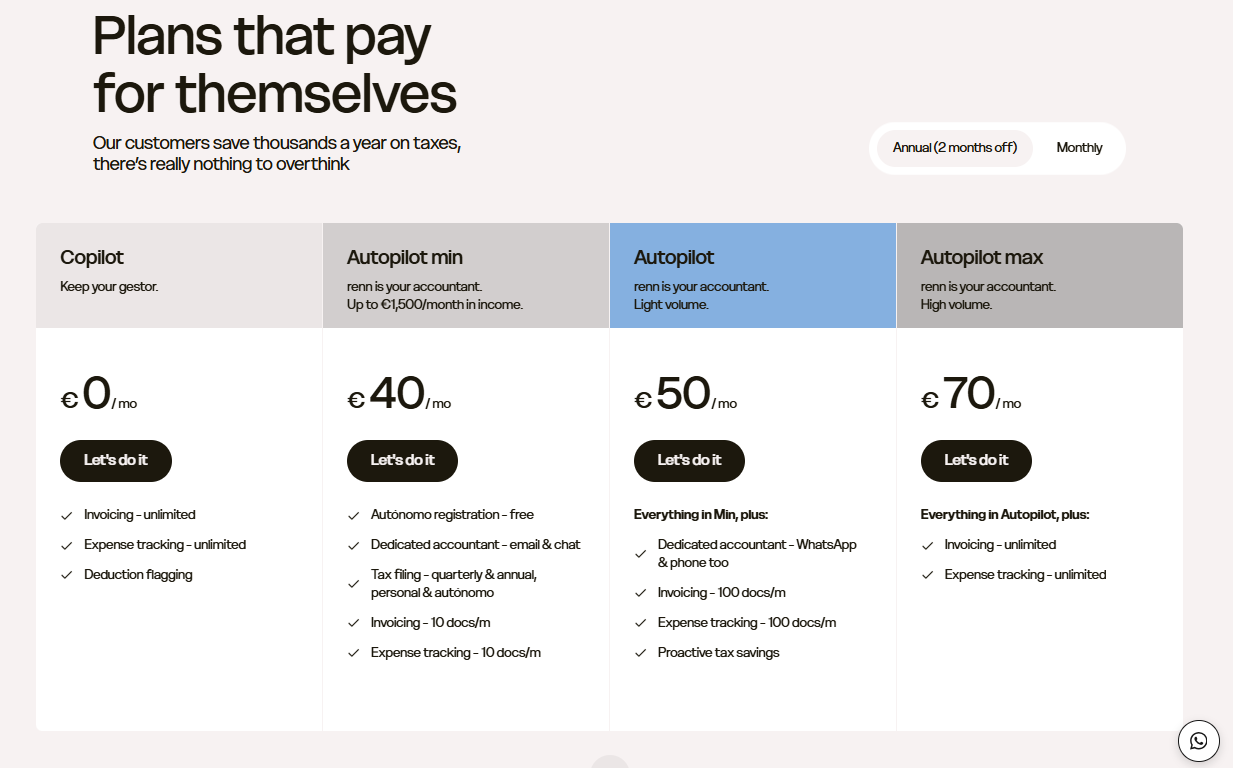
renn is an online gestoría for autónomos: a team of accountants plus a platform that does the admin. You can usWhat it does: invoicing and expense tracking with Spanish tax rules applied by default, and plans with real accountants behind them if you want to hand it over.
Price: Copilot €0 with unlimited invoices and expenses. With advisory, from €40 a month on annual billing (€50 month to month).
Pros
Cons
What it does: accounting and invoicing, widely used by accounting firms as well as by businesses directly.
Price, on annual billing: Básico €3.99, Avanzado €9.99, Profesional €19.99, Empresarial €46.66, Premium €66.66 a month.
Pros
Cons
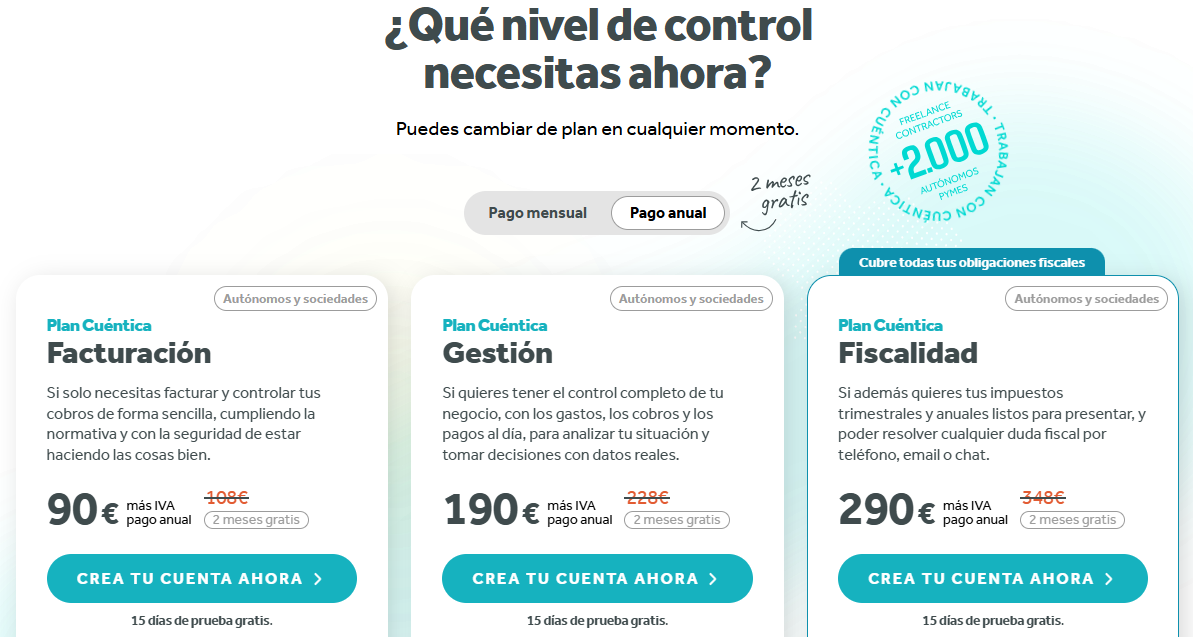
What it does: Spanish accounting tool with very clear steps, from invoicing only to having your taxes filed for you.
Price, before VAT: Facturación €9, Gestión €19, Fiscalidad €29, Fiscalidad Tutelada €59. For companies, Contabilidad Tutelada €129. Fifteen-day trial and two months free on annual billing.
Pros
Cons
What it does: invoicing and accounting with a genuinely free plan, small but real.
Price: Básico €0 with 12 documents a year, 10 clients and 5 products. Profesional €10.95 a month on annual billing, Ultimate €15.95.
Pros
Cons
What it does: the accounting module of the Zoho ecosystem, built for international use.
Price: Standard $12, Professional $24, Premium $36 a month per organisation. Billed in dollars, so your real cost moves with the exchange rate.
Verifactu: yes, with a published responsible declaration. Note it is enabled by default only on new accounts; existing customers have to request activation.
Pros
Cons
What it does: invoicing and management for Spanish freelancers, with automatic expense reading and tax forecasting.
Price: Starter €17, Solution €30, Premium €59 a month. On annual billing you pay ten months instead of twelve.
Verifactu: yes, with a published responsible declaration signed in July 2025, running exclusively in VERI*FACTU mode, meaning records go to the tax agency in real time.
Pros
Cons
What it does: a full ERP with accounting inside, alongside CRM, inventory and projects.
Price, before VAT: Plus €15, Básico €29, Estándar €59, Avanzado €99, Premium €199 a month. Some features are sold separately on top.
Pros
Cons
1 January 2027 for companies and 1 July 2027 for the self-employed. Before those dates, use is voluntary.
From your date, every invoice has to come out of a certified system producing an unalterable record and a QR code. This affects how you issue, not how you record, but in practice it is the same tool.
There is no official list of approved software. It works through the vendor's responsible declaration, so "approved by the AEAT" on a marketing page proves nothing. The full timeline is in Verifactu entry into force.
H2: When to hand it to an accountant
Doing it yourself works if you have one activity, one VAT rate, Spanish clients and no employees.
It stops working when any of these four appear:
What that service costs is in tax advisor in Spain.
Doing it yourself works if you have one activity, one VAT rate, Spanish clients and no employees.
It stops working when any of these four appear:
What that service costs is in tax advisor in Spain
Keeping the bank charge instead of the invoice. Without a full invoice carrying your tax number, the expense is not deductible.
Skipping the capital assets book. Without it you cannot justify the depreciation you are deducting.
Not keeping provisions and disbursements as a professional. It is mandatory and almost nobody does it.
Deducting personal expenses. The phone, the car and the flat are deductible only in the proportion and under the conditions the rules allow.
Recording at the end of the quarter. That is where lost receipts and invented entries come from.
If you are on the simplified direct regime, which is most likely: you do not need full accounts. You need three or four record books kept properly.
If you want it free: renn Copilot with no caps, or Contasimple if 12 documents a year fits.
If you want the cheapest with real accounting features: Anfix from €3.99 on annual billing.
If you want the official books and bank reconciliation: Cuéntica from €29, or Quipu from €17.
If you operate in several countries: Zoho Books, accepting dollar billing.
If you genuinely need an ERP: Holded, knowing you are paying for modules you may not use.
What not to do: pick the tool on its invoicing price without checking whether it produces the record books. They are different functions, and the second is the one the tax agency requires.
On the simplified direct regime, no full accounts: record books. Commercial Code accounting is required only in the normal direct regime with a commercial activity.
Business activity: sales and income, purchases and expenses, capital assets. Professional activity: those three plus provisions and disbursements.
For the record books, yes for now. For issuing invoices, from your 2027 date no: they have to come from a certified system.
On the simplified direct regime you can deduct 5% of positive net income without an invoice, capped at €2,000 a year.
They are your evidence for the tax agency and the responsibility is yours, even if you change software or accountant. Export your history once a year.
With one activity, one VAT rate and Spanish clients, software is enough. With foreign clients, employees or several activities, delegating pays for itself.
Related: Online accounting platforms / Free billing software / Tax advisor in Spain