Self-employed news 2026: the three rules that changed and what you have to do
Verifactu becomes mandatory for companies on 1 January 2027 and for autónomos on 1 July 2027. Invoicing with non-certified software after your date carries a fixed penalty of 50,000 euros per fiscal year.
Two other rules already changed. Social Security cuotas now follow your real income, and corporate tax rates dropped for small companies. If you work as an autónomo, the first two apply to you. The corporate tax change only affects companies.
This guide gives you every confirmed date, the exact figures, and a checklist by profile.
Who must comply
Autónomos are affected by two of the three changes: Verifactu and the income-based cuota. Corporate tax does not apply to them. Companies get the Verifactu obligation and the new tax rates, but not the income-based cuota.
Autónomo (files IRPF) - Verifactu from 1 July 2027 - income-based cuota already applies - corporate tax does not apply
SL with turnover under 1 million euros - Verifactu from 1 January 2027 - corporate tax at 19% and 21% from 2026
SL with turnover of 1 to 10 million euros - Verifactu from 1 January 2027 - corporate tax at 23% in 2026
New company or ENISA-certified startup - Verifactu from 1 January 2027 - corporate tax at 15% in the first profitable year and the next
Monthly VAT filer enrolled in SII - exempt from Verifactu, SII replaces it - corporate tax applies by turnover
Basque Country or Navarra under TicketBAI - exempt from Verifactu, the foral system replaces it - Social Security and corporate tax changes still apply
A foreign founder of an SL is treated as a Spanish corporate tax payer with no special regime. That means 1 January 2027, not the autónomo date.
Key dates and deadlines
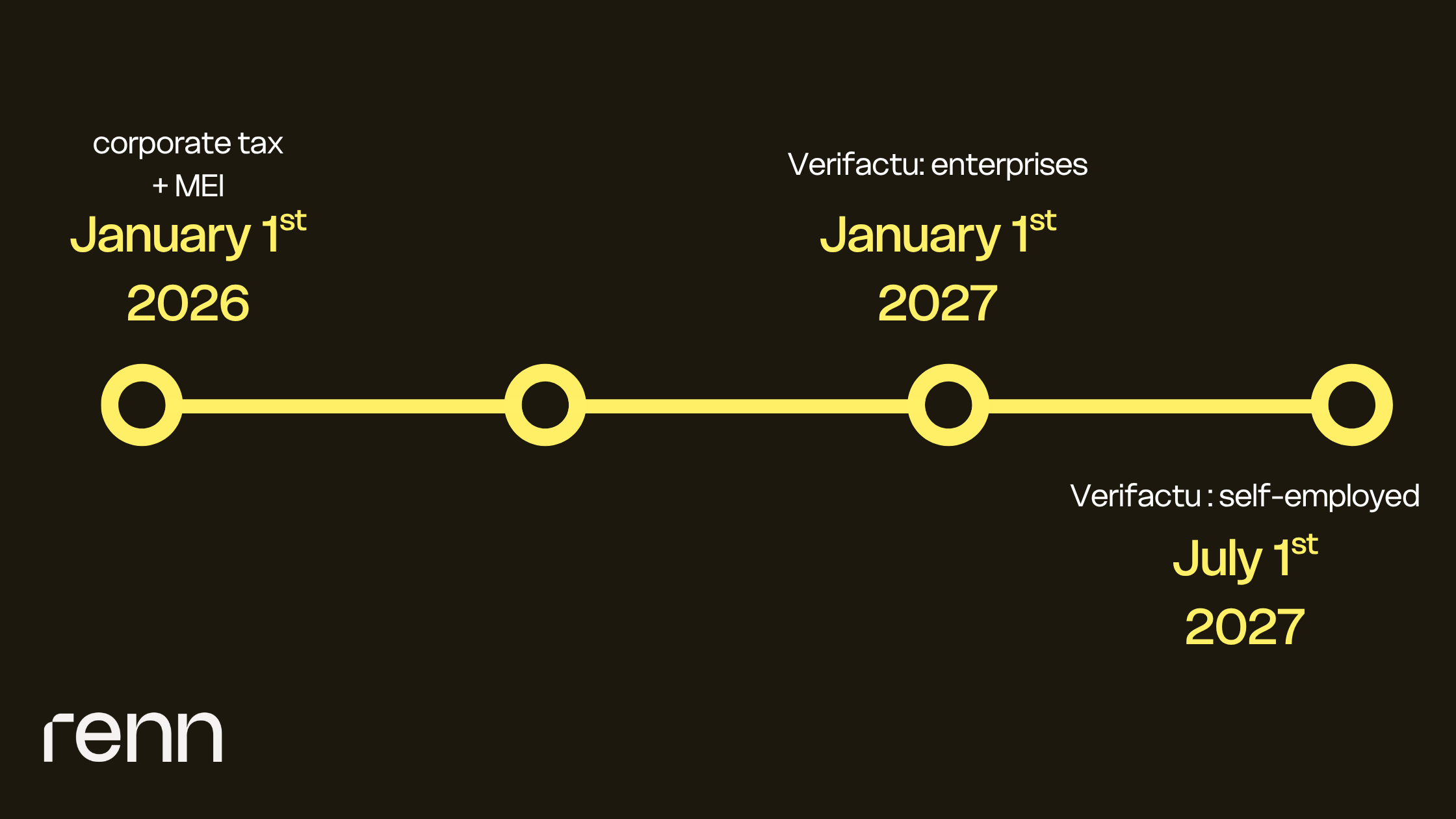
Two dates carry a penalty: 1 January 2027 for companies and 1 July 2027 for autónomos. Everything else below is already in force.
1 January 2025 - income-based Social Security cuotas came into force
April 2025 - the Agencia Tributaria opened its Verifactu services for testing, queries and QR verification
29 July 2025 - software vendors had to make Verifactu-compatible invoicing available
3 December 2025 - Real Decreto-ley 15/2025 published in the BOE, postponing Verifactu by twelve months
1 January 2026 - the new corporate tax rates apply, and the MEI rises from 0.80% to 0.90%
1 January 2027 - Verifactu mandatory for companies subject to corporate tax
1 July 2027 - Verifactu mandatory for autónomos and other IRPF filers
Verifactu was postponed to 2027, not cancelled
Verifactu was postponed by twelve months by Real Decreto-ley 15/2025, published on 3 December 2025. The obligation was not cancelled, and the Agencia Tributaria's services have been live since April 2025.
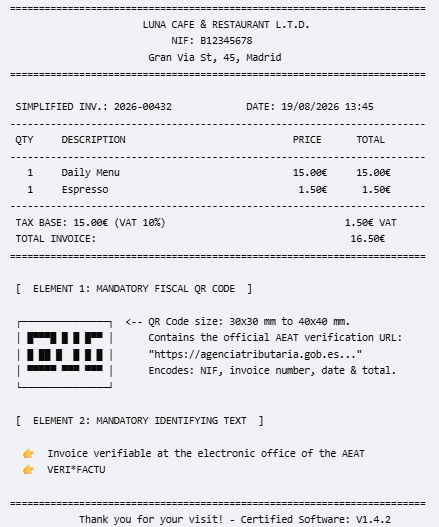
Verifactu is the certified invoicing system created to make invoice manipulation detectable. Every invoice carries a QR code and a chained hash, and in VERI*FACTU mode the record reaches the Agencia Tributaria in real time. The full mechanics are in what Verifactu is and how the records work.
What is already running today
Record submission and query. You can send invoicing records and check what you sent.
QR verification. Your customer scans the invoice and confirms it against the Agencia Tributaria.
Sandbox testing. You can test submissions and batch limits before going live.
Vendor compliance declarations. Every software manufacturer has signed one since 29 July 2025. Ask for it before you sign a contract.
Social Security cuotas now follow your real income
Since 1 January 2025 your monthly cuota is your contribution base multiplied by 31.5%. That percentage already includes the MEI, which rose from 0.80% in 2025 to 0.90% in 2026.
You estimate your annual net income, that puts you in one of 15 brackets, and the bracket sets which bases you can pick. At year end the Agencia Tributaria cross-checks what you actually earned and Social Security regularises the difference.
The figures that matter
Lowest bracket - net income up to 670 euros a month - minimum base 653.59 euros - cuota 205.88 euros a month
Highest bracket - net income over 6,000 euros a month - minimum base 1,928.10 euros - cuota 607.35 euros a month
Maximum base - 5,101.20 euros a month, which caps the cuota at 1,606.88 euros regardless of what you invoice
Base changes - up to six a year through the Importass portal
The full 15-bracket table is in the autonomo social security contributions guide. Run your own number rather than copying a table you found elsewhere. Most of the ones circulating are a year out of date.
Corporate tax rates dropped for small companies
A micro-enterprise with turnover under 1 million euros pays 19% on the first 50,000 euros of taxable base and 21% above that, from fiscal years starting on or after 1 January 2026. Reduced-dimension SMEs pay 23% in 2026.
Ley 7/2024 introduced the phased reduction, and the capitalisation reserve improved alongside it.
H3: Rates by company type
Micro-enterprise, turnover under 1 million euros - 19% on the first 50,000 euros, 21% on the rest
Reduced-dimension SME, turnover 1 to 10 million euros - 23% in 2026, falling one point a year to 20% in 2029
New entity or ENISA-certified startup - 15% in the first profitable year and the following one
Capitalisation reserve - raised from 15% to 20% of retained profit, and up to 30% if your workforce grows by more than 10%
If you file IRPF as an autónomo, none of this reaches you directly. It does change the arithmetic on whether to incorporate.
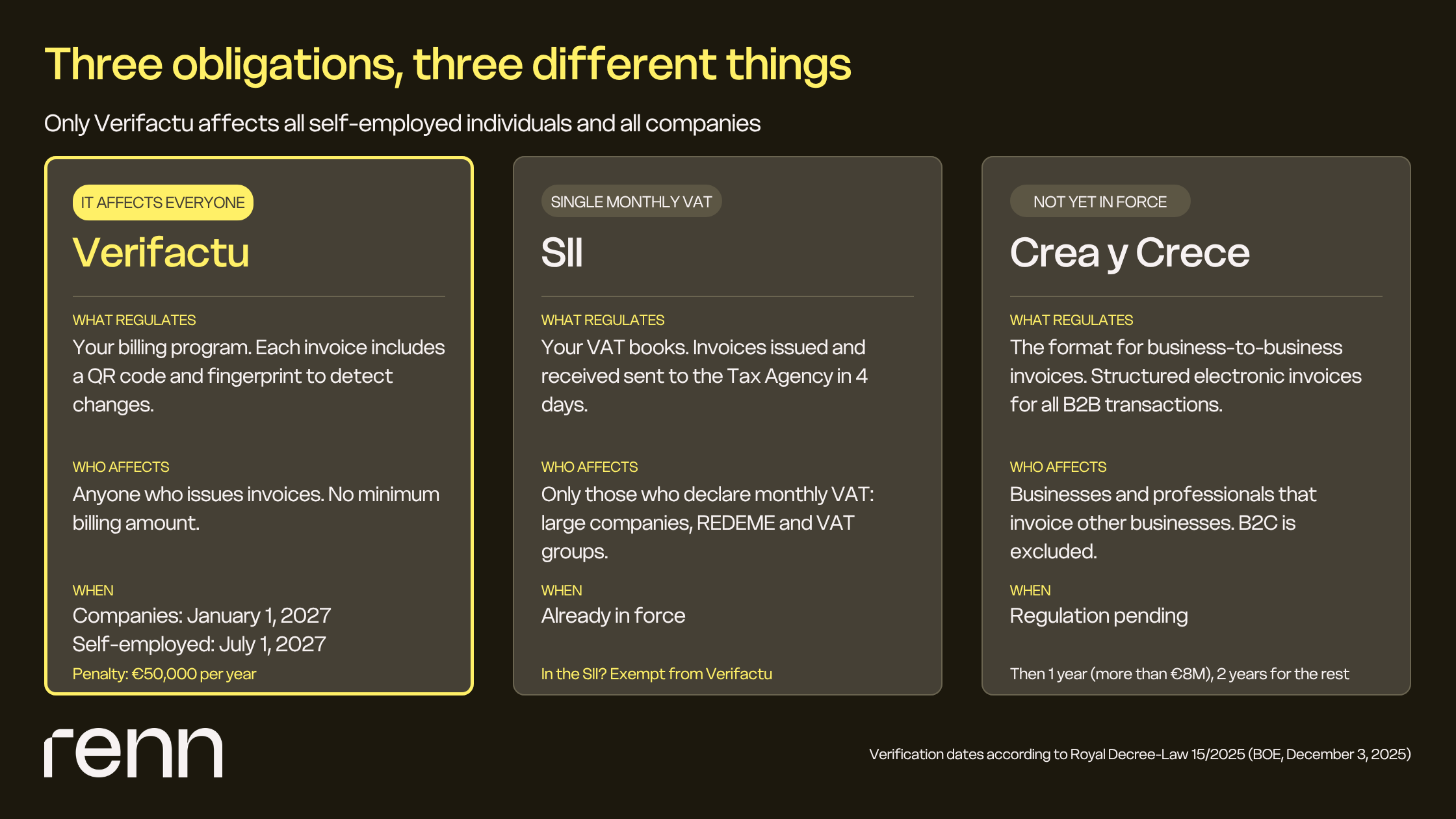
Verifactu, SII and Crea y Crece are three different obligations
Verifactu regulates invoicing software, SII regulates VAT record books, and Crea y Crece will regulate B2B electronic invoices. Only Verifactu applies to every autónomo and every company.
Confusing them costs money in both directions. People buy tools they do not need, and people assume they are covered when they are not. The wider map is in mandatory electronic invoicing.
What each one covers
Verifactu - certified invoicing software with QR code and hash chain - applies to every autónomo and company that issues invoices - mandatory 1 January 2027 for companies, 1 July 2027 for autónomos
SII (Suministro Inmediato de Información) - VAT sales and purchase books sent to the Agencia Tributaria within 4 days, or 8 for self-invoices - applies only to monthly VAT filers: large companies, REDEME and VAT groups - already in force - voluntary entry via modelo 036, and you stay in for the full year
Crea y Crece (Ley 18/2022) - B2B electronic invoicing between companies - the implementing regulation is still pending - once approved, companies over 8 million euros get one year and everyone else gets two
Penalties for non-compliance
Using non-certified invoicing software after your Verifactu date carries a fixed penalty of 50,000 euros per fiscal year, under article 201 bis of the Ley General Tributaria.
The lower end of each range applies when you correct voluntarily. The upper end applies when the Agencia Tributaria opens an inspection first.
Non-certified invoicing software after your deadline - 50,000 euros per fiscal year (LGT art. 201 bis)
Manipulating or destroying records under Verifactu - up to 150,000 euros per year, or up to 2% of turnover
Failing to regularise your Social Security base after notification - a surcharge of 10% to 35% on the unpaid contributions, plus late-payment interest
Filing corporate tax at the wrong rate - the difference plus a surcharge of 1% to 15% if you correct it yourself, or a sanction of 50% to 150% if the Agencia Tributaria finds it first
Action checklist: how to comply
Six steps, ordered by deadline. Steps 1 to 3 apply to everyone, steps 4 to 6 split by profile.
Check whether you are exempt first. If you file under SII, TicketBAI, or a foral system in Navarra, Bizkaia, Gipuzkoa or Álava, Verifactu does not apply to you and you should not be buying software for it. Confirm this before spending anything.
Open your invoicing tool's settings and look for a Verifactu mode. If the toggle is not there, the vendor will not be ready in time. Ask for their compliance declaration in writing. Several tools include Verifactu support on their free plans, so check whether you can comply at zero cost before paying for an upgrade.
Run a test submission in the sandbox. Do not wait until the week before your deadline to discover your batch limits or your error handling.
If you are an autónomo: match your contribution base to your projected net income in the Importass simulator, watch for the regularisation notice on your 2024 income, and check it against the taxes you already file. Put 1 July 2027 in your calendar.
If you run an SL: apply the correct 2026 rate this fiscal year, move invoicing to Verifactu mode well before 1 January 2027, and re-evaluate the capitalisation reserve at year end against the new 20% and 30% caps.
Verify before year-end. Confirm your base matches your real income within 500 euros a month, confirm your software has the Verifactu toggle, and confirm the rate you filed last year was the one that applied.
Common misunderstandings
These are the recurring misreadings in autónomo forums and gestoría comment threads since the postponement was announced.
"Verifactu was cancelled." No. Real Decreto-ley 15/2025 postponed it by twelve months, to 1 January 2027 and 1 July 2027. The obligation is alive and the dates are fixed.
"I am too small for Verifactu." No. There is no turnover threshold and no invoice-volume threshold. Every autónomo and every company is in scope from their own date.
"Buying compliant software early was a waste." No. Verifactu works today in voluntary mode, and a tool bought in 2025 is already ready for the cutover.
"The MEI is a one-off." No. The MEI rose from 0.80% in 2025 to 0.90% in 2026 and keeps rising through 2029.
"Lower corporate tax means I pay less personally." No. The rate cut happens at company level. You only benefit if you retain more inside the company.
"SII means I am already covered." SII does exempt you from Verifactu, but the two are separate obligations. Being Verifactu ready does not put you in SII.
What happens if these rules change again
Verifactu has been postponed twice, so a third delay cannot be ruled out. What changed is that the technical side is finished and running, which raises the cost of moving the date again.
The corporate tax schedule is locked through 2029 by Ley 7/2024, though any annual budget law can amend it. The Social Security bracket structure is due for review for 2027, because the current freeze is a one-year measure.
FAQ
When is Verifactu mandatory?
1 January 2027 for companies subject to corporate tax, and 1 July 2027 for autónomos and other IRPF filers. Real Decreto-ley 15/2025 postponed the earlier 2026 dates by twelve months.
Was Verifactu cancelled?
No. Verifactu was postponed, not cancelled. Real Decreto-ley 15/2025, published in the BOE on 3 December 2025, moved the dates to 1 January 2027 and 1 July 2027.
How much is the autónomo cuota in 2026?
Your contribution base multiplied by 31.5%, with the MEI at 0.90% already included. The lowest bracket pays 205.88 euros a month. The maximum base of 5,101.20 euros caps the cuota at 1,606.88 euros.
Am I exempt from Verifactu?
Yes, if you file under SII, TicketBAI, or the foral systems of Navarra, Bizkaia, Gipuzkoa or Álava. There is no exemption based on turnover, invoice volume or company size.
Is SII the same as Verifactu?
No. SII is the submission of VAT record books within 4 days and applies only to monthly VAT filers. Verifactu is certified invoicing software with QR codes and hash chains, and applies to almost every autónomo and company.
What is the corporate tax rate for a small company in 2026?
19% on the first 50,000 euros of taxable base and 21% above that, for turnover under 1 million euros. Companies with turnover of 1 to 10 million euros pay 23% in 2026.