
If you only bill Spanish clients and want someone to file your taxes for you, Xolo is cheaper: its Local plan costs €39 a month plus VAT, against €49.90 plus VAT for Declarando's cheapest plan with taxes. If you already have a gestor (a Spanish accountant who files your returns) and only want software, Declarando costs less.
The two are built differently. Xolo is an online gestoría: its accountants file your quarterly returns for you. Declarando works two ways. On its plans with taxes, you don't need a gestor: the app keeps your records up to date, calculates every return and you submit it to Hacienda in one click, with its tax experts on hand. Declarando describes it as being your own tax adviser. On its plans without taxes, it is software for people who keep their own gestor.
Xolo fits freelancers with foreign clients and anyone who wants to work in English. Declarando fits Spanish speakers who earn a steady income from Spanish clients and like seeing their numbers in an app. The cost most people miss is the billing model: Declarando's published prices assume a full year paid up front, while Xolo bills month to month.
Each category below compares the same point for both services, using their own Xolo pricing page and Declarando pricing page. All prices exclude VAT, which adds 21%.
Price with tax filing included
Price for software only
Who files the quarterly returns
Annual income tax return (renta)
VeriFactu invoicing
Foreign clients
Self-employed registration (alta de autónomo)
Support and response times
Language
Contract and cancellation
Free trial
Reviews on Trustpilot
With Xolo, an accountant prepares and files your returns. You upload invoices and receipts, and the filing is their job. With Declarando's plans with taxes, you file without a gestor: the app calculates your returns, warns you when the filing window opens, and you submit them to Hacienda yourself.
That changes who answers for a mistake and how much of your time each quarter takes. Declarando's Básico and Pro plans suit people who want to understand their numbers and don't mind one click per return. Xolo suits people who want the whole job handed over.
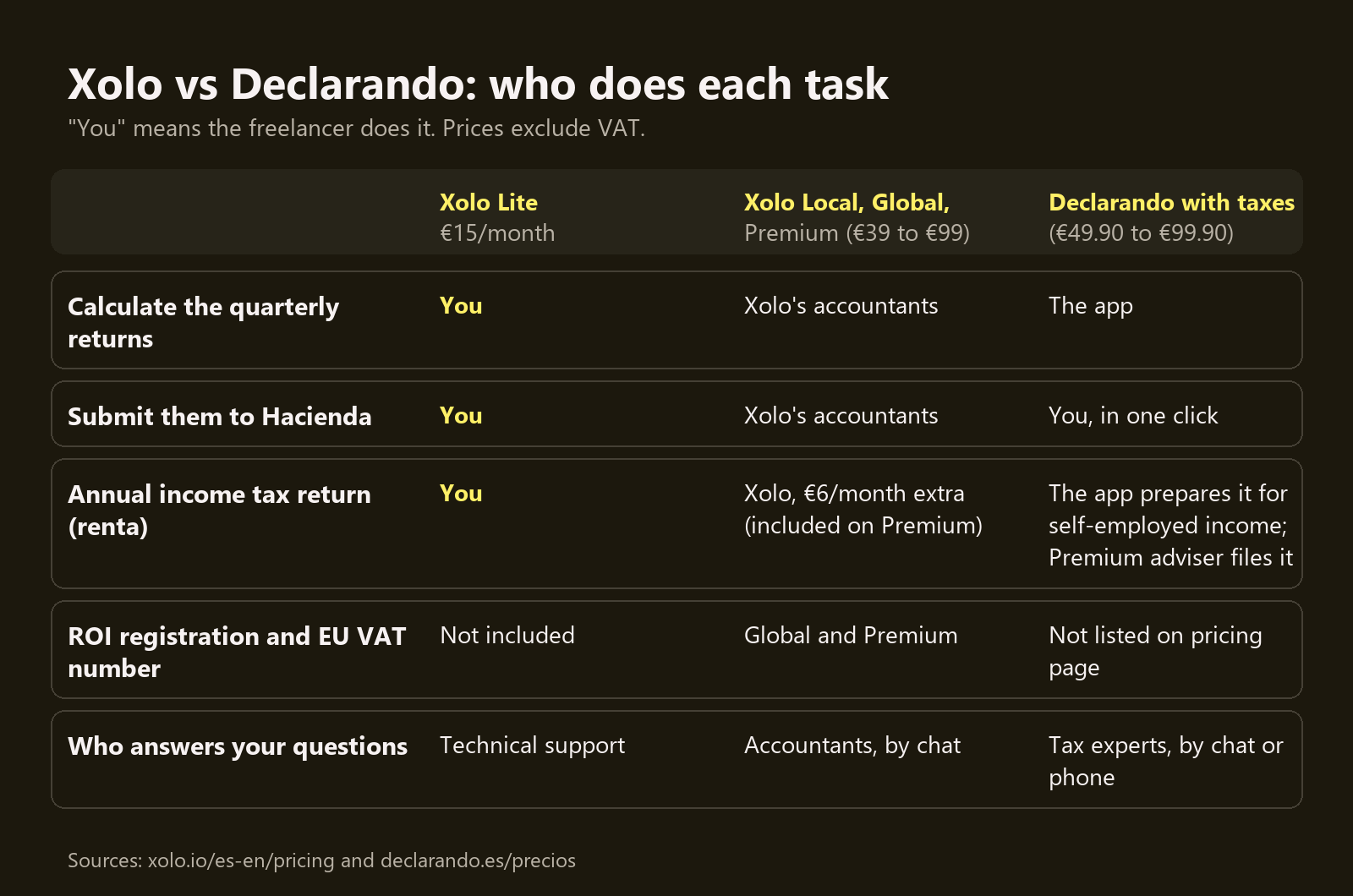
Two details sit behind this split. Xolo only files the quarterly returns if you join before the 25th of the quarter's last month. Declarando's Pro and Premium plans also handle requirements (formal letters) from Hacienda for you, while Premium adds an adviser who reviews every return before it goes out.
Over twelve months, Xolo is cheaper for most freelancers with Spanish clients, and the gap grows with your income. Declarando prices its plans by how much you earn, while Xolo charges the same whatever you invoice.

The break-even point is the €1,000 monthly income line. Below it, the two cost about the same once you add Xolo's renta. Above it, Declarando's price jumps and Xolo's doesn't.
Xolo lists every form it files on its pricing page. On Local, Global and Premium, its accountants file these quarterly returns:
Once a year it also files the summaries that close those quarters: modelos 180, 190, 390 and 347. These need a minimum stay of six months on Local and Global and three months on Premium. Renta comes as Modelo 100, or Modelo 151 if you are under the Beckham law.
Declarando's pricing page doesn't list forms by number. It says the plans with taxes prepare your quarterly returns automatically and that you submit them on the Hacienda website. Its renta on Básico and Pro covers self-employed income only, so a salary, rental income or investments need the Premium plan, where an adviser files it.
Both services already invoice in line with VeriFactu, so neither choice leaves you exposed. VeriFactu is Spain's rule for certified invoicing software: every invoice gets a record that can't be edited afterwards, and the software can send it to Hacienda.
Royal Decree-law 43/2026 moved the deadline to use certified software so it matches the last stage of mandatory e-invoicing between businesses, which falls on 6 October 2028. Xolo includes VeriFactu invoicing on every plan, Lite included. Declarando gives unlimited invoicing on every plan and blocks gaps in your invoice numbering, which the rule forbids.
Xolo is the safer pick if you invoice clients abroad. Its Global plan, at €59 a month, files your ROI registration, gets you an EU VAT number, adds Modelo 349 to your quarterly returns and lets you invoice in other currencies.
Declarando's pricing page doesn't mention ROI registration, EU clients or foreign currencies. If most of your income comes from abroad, ask Declarando in writing whether it handles the ROI and Modelo 349 before you pay for a year.
Xolo works fully in English: its website, app and support, including the live chat with its accountants. Declarando's website and pricing page exist only in Spanish, and its plans don't mention support in any other language.
For a freelancer who moved recently, this often settles the choice. Tax letters from Hacienda arrive in Spanish, so having support that explains them in English is worth more than the price gap between the two.
Declarando has the higher score and eight times more reviews, but also a larger share of one-star ratings. On Trustpilot, Declarando scores 4.2 out of 5 from 4,109 reviews, and Xolo scores 4.0 from 528.
Read the one-star reviews before you sign up, since they show what goes wrong when it does. Xolo's profile also covers its services in Italy and Estonia, so not every review is about the Spanish plans. For more detail on Xolo, see our Xolo reviews.
Xolo is an online gestoría that only works with self-employed people. Its accountants file your quarterly and annual returns for a flat monthly fee, in English or Spanish, and its Global plan covers clients abroad.

Declarando lets self-employed people file their own taxes without a gestor, with tax experts behind the app and prices set by income. It keeps your records up to date, prepares your returns, forecasts what you will owe and lets you submit with one click, while Premium adds a personal adviser.

You can move between them at any time, but timing saves money. Most of the cost of switching comes from minimum stays and from joining mid-quarter.
No. On its plans with taxes you don't need a gestor: the app prepares every return, you submit it in one click, and tax experts answer your questions by chat or phone. Premium adds a personal adviser who reviews your returns and files your renta.
No. Lite is invoicing and expenses only, Local files your returns for Spanish clients, Global adds clients abroad and the ROI, and Premium adds renta, priority support and phone advice.
Not on its plans with taxes, since the app prepares your quarterly returns. On its plans without taxes, yes: those are built for people whose gestor keeps filing.
Declarando gives seven days free on any plan. Xolo's pricing page shows no free trial, but you can cancel any month.
With Xolo, yes, though free registration and the annual returns need a minimum stay. With Declarando you pay for a year, with 14 days to ask for your money back.
For tax filing with Spanish clients, Xolo Local at €39 a month is cheaper than Declarando's €49.90 or more. For software only, Xolo Lite at €15 costs less than Declarando's €29.90, but Declarando's software plans include more tools.
Xolo does: its pricing page has a separate Canary Islands option for Local and Global. Declarando's pricing page doesn't mention the Canary Islands or IGIC (the islands' own sales tax, which replaces VAT there), so ask before you sign up.
Xolo, if you want registration and every filing handled while you learn how the system works. Declarando, if you earn under €1,000 a month and want an app that shows each quarter how much tax you will owe.
Xolo files it for €6 a month on Local and Global and at no extra cost on Premium. Declarando prepares it for self-employed income on Básico and Pro, and its Premium adviser files it for you, complex cases included.