VAT exemptions for autónomos in Spain: who qualifies
Most autónomos in Spain must charge IVA on every invoice. But a specific list of activities is legally exempt under Article 20 of Ley 37/1992. If your activity is on that list, you do not charge IVA to clients, you do not file Modelo 303, and you cannot deduct the IVA you pay on your business expenses. The exemption is determined entirely by what you do, not by how much you earn. Spain has no turnover threshold that makes you IVA-exempt below a certain revenue level. Getting this wrong in either direction has consequences: charging IVA when you are exempt overcharges your clients; not charging IVA when you should means you owe AEAT the uncollected amount plus penalties. If you are still figuring out how IVA works in general, start with what is IVA in Spain before reading this guide.
TL;DR: are you IVA-exempt?
IVA exemption in Spain is based on your activity type, not your revenue
There is no small business turnover threshold for IVA exemption in Spain (unlike UK or Germany)
Exempt activities are listed in Article 20 of Ley 37/1992
Main exempt sectors: healthcare, education, financial services, insurance, and certain cultural activities
If you are exempt: no IVA on invoices, no Modelo 303, and no IVA deduction on your expenses
If you are NOT exempt: you charge IVA (usually 21%) and file Modelo 303 every quarter
Check out this video on our YouTube channel, which explains the process step by step.
01. The rule: activity type decides, not revenue
The single most common misconception among new autónomos is that IVA exemption applies automatically below a certain income level. This is not how Spain works. There is no equivalent of the UK's £90,000 VAT threshold or Germany's Kleinunternehmerregelung in Spanish tax law. Every autónomo who carries out a taxable activity must charge IVA from the first euro billed, regardless of annual turnover.
The only route to IVA exemption is carrying out an activity that falls within the exempt categories defined in Article 20 of Ley 37/1992. Those categories are fixed in law. Your AEAT classification code (epígrafe del IAE), which you selected when you registered as a freelancer in Spain, is the starting point, but the actual activity you perform is what matters if there is a dispute.
02. Activities that are IVA-exempt
The following activities are exempt from IVA under Article 20 of Ley 37/1992. This covers the categories most relevant to autónomos:
Healthcare and medical services. Doctors, dentists, nurses, physiotherapists, occupational therapists, opticians, and psychologists providing clinical services. The exemption applies to the medical act itself, not to any commercial activity alongside it: selling glasses frames is taxable, but the eye test is not.
Teaching and education. Regulated education at officially recognised centres: schools, universities, official language academies, and vocational training centres. Private tutoring by individuals is also exempt if it covers subjects included in the official education curriculum. Online courses and coaching that are not regulated education are generally NOT exempt.
Social welfare services. Services provided by recognised social welfare entities, care homes, and similar organisations. Private autónomos operating as social workers in non-institutional settings should verify with a gestor, as the exemption conditions are specific.
Financial and insurance services. Loans, credit operations, insurance, and reinsurance. Relevant for autónomos working as insurance agents or financial intermediaries with the correct regulatory authorisation.
Cultural services provided by public bodies. Museums, libraries, archives, and similar public entities. Private autónomos in the cultural sector are generally NOT covered by this exemption.
Writers and artists (partial exemption). Authors who cede the rights to their literary, artistic, or scientific work are exempt on those rights-transfer services. This applies to royalty income, not to any other service they provide.
Real estate transactions (specific cases). The first sale of a building is subject to IVA, but subsequent sales are generally IVA-exempt (subject to ITP instead). This affects autónomos working in property.
03. Activities that are NOT exempt, even if you might expect them to be
These are the most frequent cases where autónomos wrongly assume they are exempt:
Freelance consultants, lawyers, architects, and engineers. Professional services are fully subject to IVA at 21%, regardless of the size of the practice or annual revenue.
Coaches, trainers, and online course creators. Unless the course is part of the official regulated education system, online training and coaching is taxable. A fitness coach, a business coach, or a language teacher operating independently charges IVA at 21%.
Freelance designers, developers, marketers, and creatives. All standard professional services in these categories are subject to IVA.
Therapists who are not regulated health professionals. Alternative therapists, life coaches, and practitioners of non-regulated treatments do not qualify for the healthcare exemption. The exemption requires a regulated health profession recognised by Spanish law.
Psychologists providing non-clinical services. Clinical psychology is exempt. Organisational psychology, coaching, or HR consulting carried out by a psychologist is not.
Freelance journalists and content writers. Writing services are subject to IVA. The author exemption covers the cession of intellectual property rights on completed works, not ongoing writing services billed on invoices.
04. How to verify if your activity is exempt
Check your IAE epígrafe. When you registered as autónomo, you selected an economic activity code on Modelo 036 or 037. Look up that code and check whether it falls within Article 20 of Ley 37/1992. AEAT's website publishes the full legal text.
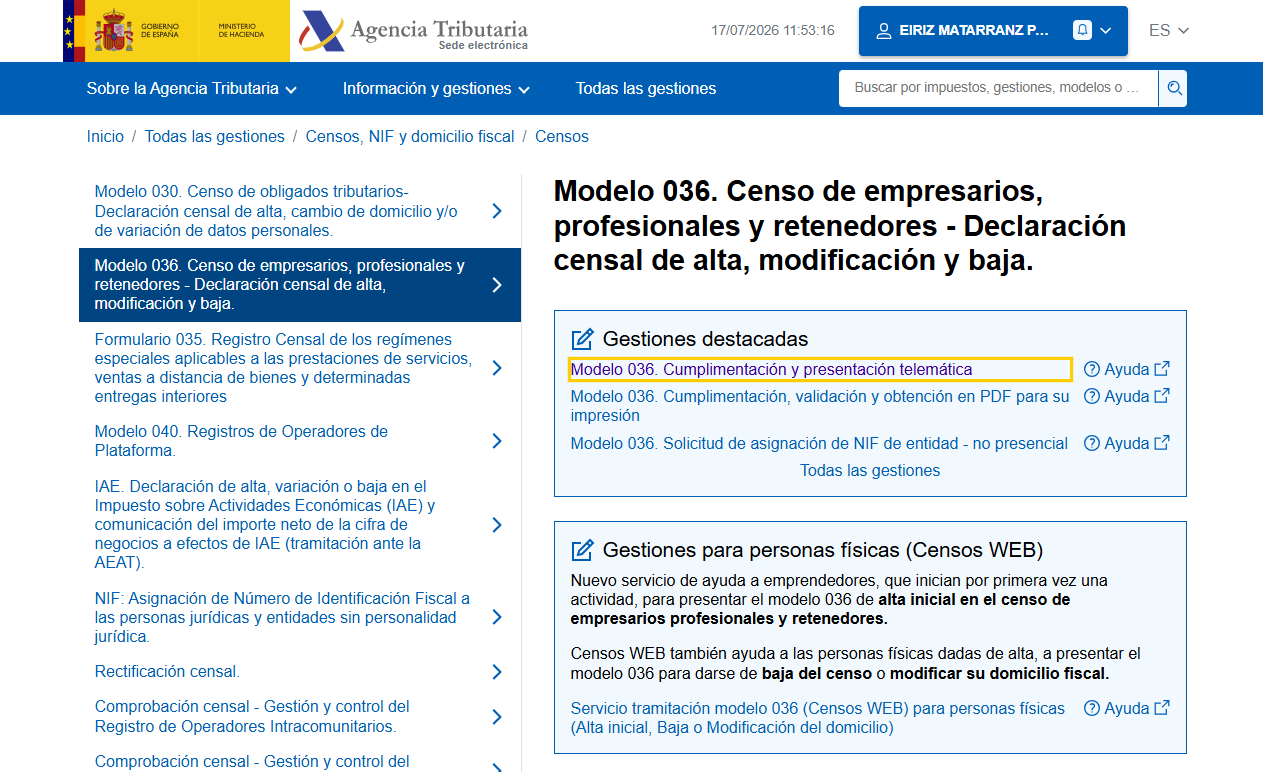
Check your Modelo 036 or 037. Box 650 of Modelo 036 is where you declared whether your activity is subject to IVA or exempt. You can view your registration data through AEAT's Sede Electrónica.
Request a consulta vinculante. If your activity sits on the boundary between exempt and taxable, which is common for psychologists, educators, and health-adjacent professionals, you can submit a formal binding consultation to AEAT. They are legally obliged to respond, and their response is binding on them.
Ask a gestor with IVA exemption experience. The boundary cases are genuinely complex. A gestor who has filed for similar professionals in your sector will know what AEAT typically accepts.
05. What IVA exemption means in practice
If your activity is exempt, three things change:
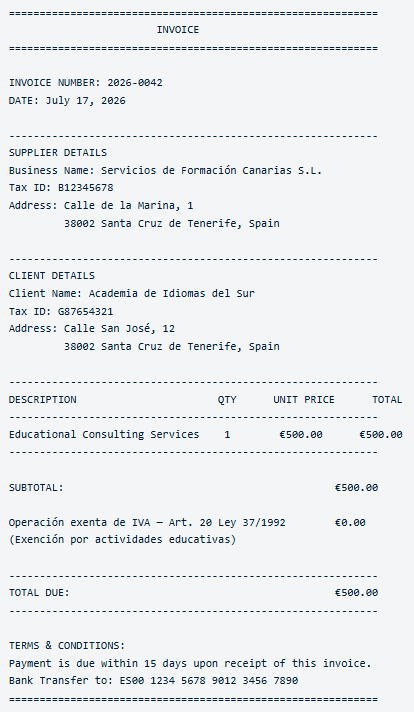
You do not add IVA to your invoices. Your invoice shows only the net amount. You do not write "IVA 21%" or "IVA 0%". The invoice has no IVA line, or you add a note: "Operación exenta de IVA — Art. 20 Ley 37/1992."
You do not file Modelo 303. The quarterly IVA return does not apply to you. You only file Modelo 100 (annual IRPF) and Modelo 130 (quarterly IRPF advance payments). For a full breakdown of what taxes autónomos pay, see autonomo costs.
You cannot deduct the IVA you pay on business expenses. When you buy a laptop, software, or office supplies, you pay IVA on those purchases. Taxable autónomos recover that IVA through Modelo 303. Exempt autónomos cannot. The IVA you pay on expenses becomes a cost you absorb. For a full list of what counts as a deductible expense, see deductible expenses for autónomos in Spain.
Whether exemption is financially beneficial depends on your expense level and your client type. If your clients are businesses that would recover IVA anyway, being taxable costs you nothing with them. If your clients are consumers who cannot recover IVA, being exempt makes your prices cleaner. A gestor can model both scenarios for your specific situation.
Some autónomos carry out both exempt and taxable activities. A doctor who also sells health supplements. A teacher who also sells online courses outside the regulated curriculum. A writer who also offers editorial consulting.
In these cases, you apply IVA to the taxable part and not to the exempt part. Each invoice must clearly identify which services are exempt and which are not. You file Modelo 303 covering only your taxable operations, and you apply a pro-rata rule (prorrata) to determine what proportion of your input IVA on expenses you can deduct. The prorrata is calculated as taxable revenue divided by total revenue. This is one of the more complex areas of IVA management and is worth reviewing with a gestor annually.
VAT exemptions for autónomos: frequently asked questions
Is there a revenue threshold below which autónomos do not charge IVA in Spain?
No. Spain has no small business IVA exemption based on turnover. Every autónomo carrying out a taxable activity charges IVA from the first euro, regardless of annual revenue. The exemption is determined by activity type only, under Article 20 of Ley 37/1992. For more on how IVA works, see what is IVA in Spain.
Can I choose to be IVA-exempt even if my activity is taxable?
No. If your activity is taxable, you are required to charge IVA. It is not optional. Choosing not to charge IVA on a taxable activity means AEAT can demand the uncollected IVA from you, plus late payment interest and a penalty.
I am a psychologist. Am I IVA-exempt?
It depends on what type of services you provide. Clinical psychology (diagnosis, treatment, therapy for mental health conditions) is exempt under the healthcare exemption. Organisational psychology, coaching, training, or HR consultancy carried out by a psychologist is taxable at 21%. If you provide both, you apply mixed-activity rules.
I teach English privately. Am I IVA-exempt?
Possibly. If the classes cover subjects included in the official education curriculum and you are an individual teacher (not operating through a non-recognised centre), the exemption under Article 20.1.9 of Ley 37/1992 may apply. However, AEAT applies this narrowly. General conversation classes or adult language learning outside the school curriculum are often treated as taxable. A consulta vinculante is the safest way to confirm your specific situation.
What happens if I charged IVA incorrectly for years?
If you charged IVA when you were exempt, you overcharged clients and would need to issue corrective invoices and return the IVA collected. If you did not charge IVA when you were taxable, AEAT can assess the uncollected amount for the years within the statute of limitations (four years), plus interest and penalties. Regularise voluntarily before AEAT contacts you to reduce the penalty amount.
Do IVA-exempt autónomos still pay IRPF?
Yes. IVA exemption has no effect on IRPF. Exempt autónomos pay income tax on their net profit exactly like any other autónomo. They file Modelo 130 quarterly and Modelo 100 annually. The only difference is that they do not file Modelo 303. More on autónomo taxes: autonomo costs.