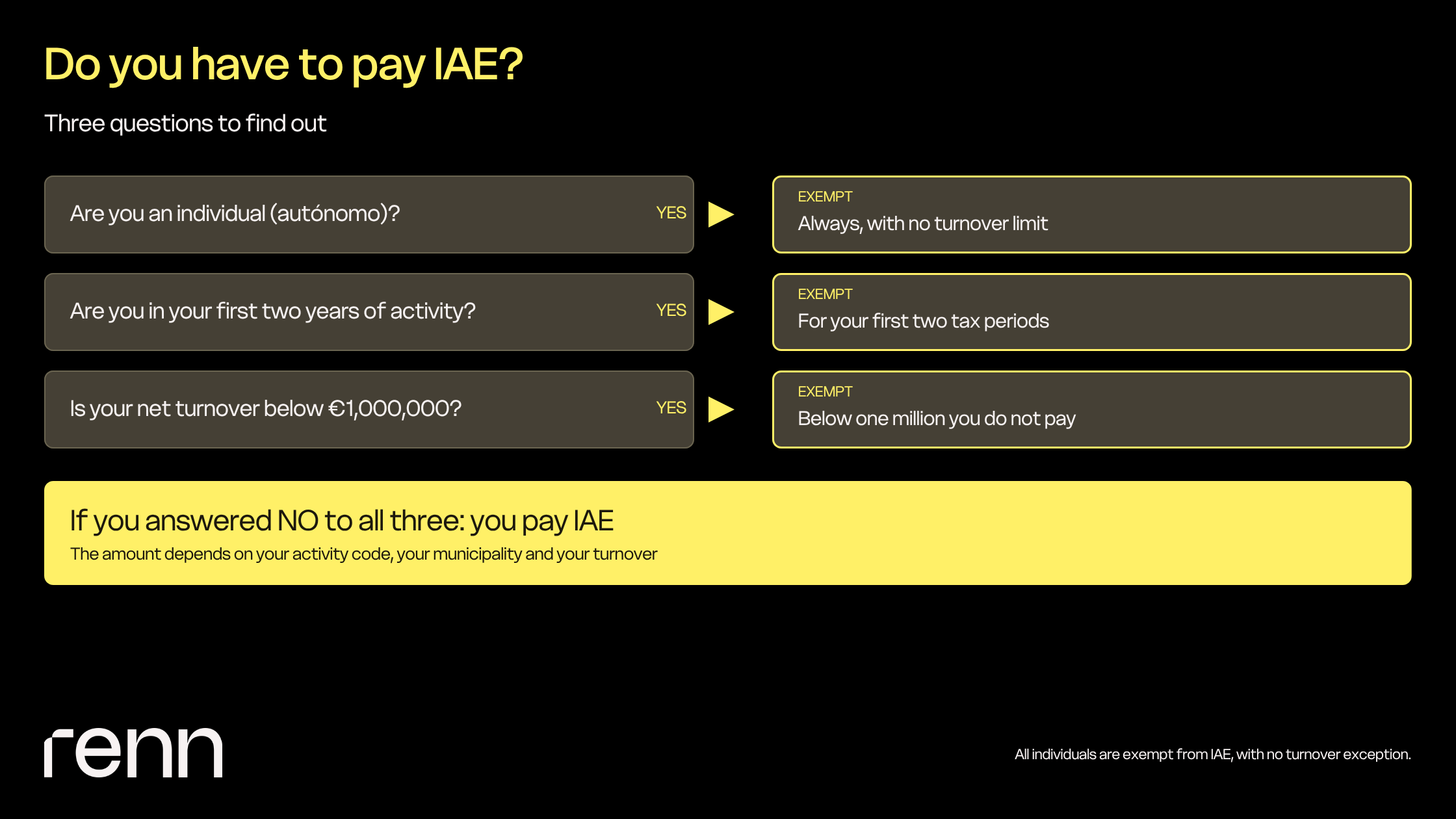
If you are an autónomo operating as an individual, you do not pay IAE. You are exempt permanently, no matter how much you invoice.
The business activity tax is only paid by companies whose net turnover exceeds one million euros. And not even those during their first two years of activity.
You still have to choose an IAE activity code when you register, because it shapes how you are taxed. Here is who pays, how much, and how to find yours.
Quick answer
Autónomo (individual): exempt permanently, with no turnover limit
Company with net turnover under €1,000,000: exempt
Company with net turnover above €1,000,000: pays, except during its first two years of activity
Everyone, exempt or not: must declare an activity code on Modelo 036 or 037
The rates are set by law, with a fixed amount per activity code
Who is exempt from IAE
The exemption is wide, which is why almost nobody searching for this tax ends up paying it.
Exempt from payment:
All individuals. If you are an autónomo and have not incorporated a company, you never pay IAE. There is no turnover threshold that removes the exemption.
Companies with net turnover below €1,000,000. The reference figure is the net turnover of the year before last.
Any taxpayer during their first two tax periods of activity, individual or company.
Non-profit entities and certain public bodies, under their own conditions.
Being exempt does not mean not declaring
This is the confusion that causes most problems. The exemption is from paying, not from the registration obligation.
Anyone starting an economic activity must declare their IAE code on Modelo 036 or 037. That code defines your activity for AEAT and carries consequences: it determines whether you can use the módulos regime, what withholding your clients apply, and which expenses count as related to your activity.
If you are liable and not exempt, you also file Modelo 840 for registrations, deregistrations and changes.
How the rate is calculated if you do pay
The rate is not a percentage of your income. It starts from a fixed amount per activity code, which is then adjusted in three steps.
The order matters, because each coefficient applies to the result of the previous one.
The four elements of the calculation
The tariff amount. A fixed figure assigned to your activity code in the official tariffs. It can be municipal, provincial or national depending on the scope you want to operate in.
The surface element. Many codes add an amount per square metre of the premises used for the activity.
The weighting coefficient. Multiplies the amount according to your turnover, and is set by law identically across Spain.
The location coefficient. Set by each town hall according to the street category where the premises are, and applied only to municipal quotas. This is why the same business pays differently on two streets in the same city.
The weighting coefficient, band by band
It depends on your net turnover and is set in article 86 of the local finance law.
€1,000,000 to €5,000,000 - coefficient 1.29
€5,000,000.01 to €10,000,000 - coefficient 1.30
€10,000,000.01 to €50,000,000 - coefficient 1.32
€50,000,000.01 to €100,000,000 - coefficient 1.33
Above €100,000,000 - coefficient 1.35
No net turnover figure - coefficient 1.31
The table starts at one million because below that figure you are exempt. The lowest coefficient anyone actually pays is therefore 1.29.
The location coefficient
Each town hall sets it in its fiscal ordinance, within the limits of article 87 of the same law.
It cannot be lower than 0.4 nor higher than 3.8
Each municipality must set between 2 and 9 street categories
The difference between one category and the next cannot be less than 0.10
The provincial surcharge
Provincial councils may add a surcharge on IAE, regulated in article 134. It is a single percentage applied to municipal quotas already modified by the weighting coefficient, and it cannot exceed 40%.
Not every provincial council applies it, so check your own council's ordinance.
The three types of rate
Choosing an activity code also means choosing the territory you can operate in, and that changes what you pay.
Municipal. Allows you to operate in one specific municipality. The cheapest and most common.
Provincial. Lets you operate across the whole province without registering in each municipality.
National. Covers the entire country. The most expensive, and only worth it for genuinely distributed activities.
Choosing the national rate for convenience when you operate in a single city is a common way to overpay.
How to find your activity code
The tariffs and the classification are set by law, so the full list is public and searchable.
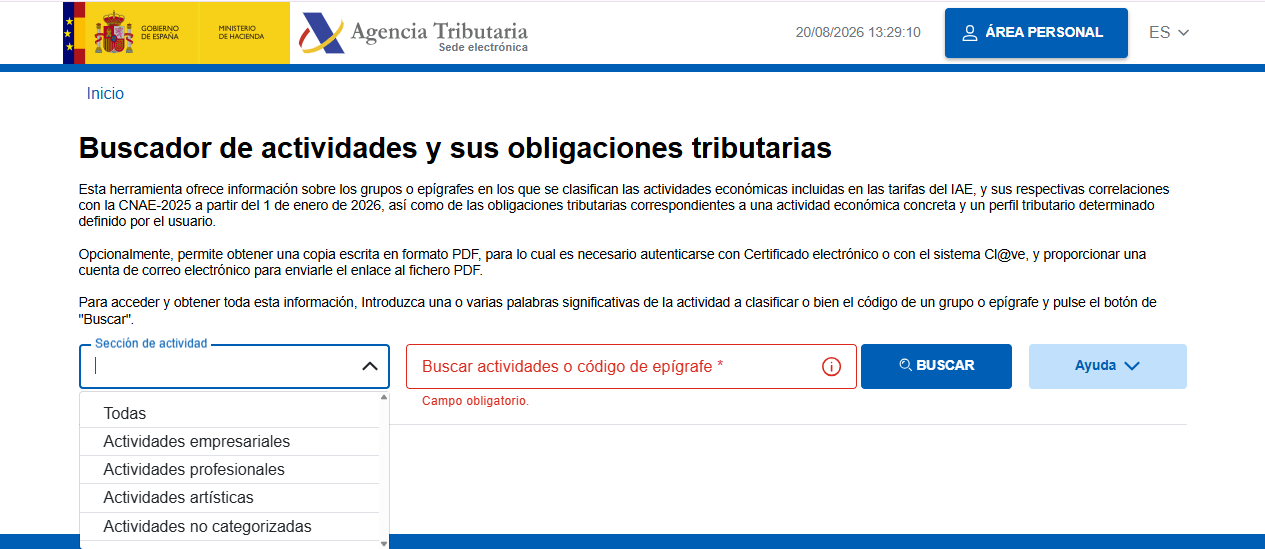
Use AEAT's activity search tool. On the Sede Electrónica you can search by keyword and see which codes match what you do.
Check the official tariffs. The full classification with the amount for each code is published in the BOE.
Separate business from professional activities. Professional activities sit in a different section and have different consequences, especially for the withholding your clients apply.
Why your code matters even if you pay nothing
Choosing the wrong code costs you nothing in IAE if you are exempt, but it costs you everywhere else.
It determines whether you can use módulos. Only certain activities are included in the objective estimation regime. Detail in self-employed modules.
It determines withholding on your invoices. Professional activities carry IRPF withholding; business activities generally do not.
It shapes which expenses are deductible. AEAT assesses whether an expense fits the declared activity.
It gets cross-checked against your filings. A code that does not match what you invoice is a signal AEAT picks up.
If you are liable and not exempt, IAE is collected by your town hall, not by AEAT.
The collection period is set by each municipality, usually in the second half of the year, and published in the municipal tax calendar.
It is paid as an annual bill, which can be set up by direct debit like property tax.
If you register mid-year, the first year's amount is prorated by calendar quarters.
If you cease activity, you must file the deregistration to stop receiving the bill. It does not stop automatically.
What happens when you stop being exempt
This is the situation that catches growing companies by surprise.
If your company exceeds one million euros in net turnover, the exemption ends. The change is not immediate: the reference is the figure from the year before last, so you have time to plan for it.
What you must do is register in the tax roll using Modelo 840 within the set deadline. Not doing so does not avoid the debt, it just adds a surcharge.
Common mistakes with IAE
Assuming autónomos have to pay it. Individuals are always exempt. If someone has charged you IAE as an individual autónomo, check it.
Confusing exemption from payment with not declaring a code. They are separate. The activity code is mandatory for everyone on Modelo 036 or 037.
Choosing the national rate without needing it. If you operate in one municipality, the municipal rate applies and is far cheaper.
Picking the closest code instead of the correct one. It carries consequences for módulos, withholding and deductions for years.
Not deregistering the code when you stop trading. The bill keeps arriving and the debt keeps building.
Not planning for losing the exemption. Crossing one million triggers a registration obligation, and the deadline runs whether or not anyone reminds you.
Frequently asked questions
Do autónomos pay IAE in Spain?
No. All individuals are exempt from IAE, with no turnover limit. If you are an autónomo and have not incorporated a company, you do not pay this tax, although you must still declare your activity code when you register.
At what point does IAE become payable?
Companies start paying when their net turnover exceeds one million euros, measured on the year before last. Below that figure they are exempt.
What is an IAE activity code (epígrafe)?
It is the code that classifies your economic activity within the official tax tariffs. You choose it when registering with AEAT, and it defines what you do for the tax authority, with effects on módulos, withholding and deductions.
Can I have more than one activity code?
Yes. If you carry out several distinct activities you must declare a code for each. Each one follows its own rules, so it is worth keeping clear which income belongs to which activity.
Is IAE collected by AEAT or the town hall?
Collection is municipal: the town hall issues and collects the bill. Registration in the tax roll, through Modelo 840, is handled by AEAT.
How do I change my activity code?
By filing a modification declaration on Modelo 036 or 037. If you are liable and not exempt, the change must also be reflected on Modelo 840.